Rosemary Flower Coloring Page for Adults: Practical Design Asset for Print-on-Demand and Creative Workflows
Adult coloring pages have moved beyond simple pastime activities. For creators, small business owners, and publishers, they represent a structured entry point into product design, print-on-demand, and digital asset management. Among the many botanical themes available, the rosemary flower coloring page for adults stands out for its detail, symbolism, and adaptability. When paired with a vector-based design system like the digital ivy flower graphic described here, this asset becomes more than a single image. It becomes a modular component that fits into publishing workflows, product decoration, and even brand-specific creative projects.
Understanding how to use a rosemary flower coloring page for adults effectively requires looking at the entire production chain. From the initial download to the final product listing, each step benefits from preparation, file format awareness, and a clear sense of where the design fits into your larger process. This article walks through the practical aspects of working with such a graphic, covering integration points, file handling, and real-world applications across multiple channels.
What the Rosemary Flower Coloring Page for Adults Actually Contains
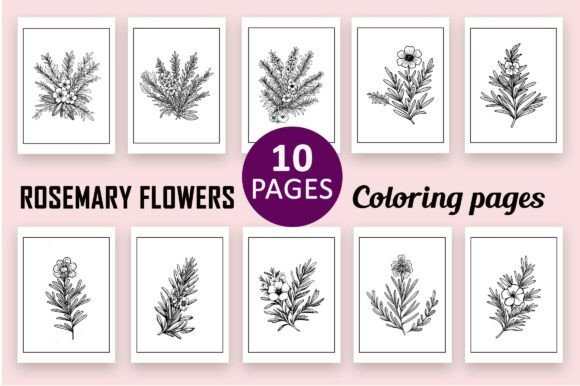
At its core, a rosemary flower coloring page for adults is a line art illustration designed for relaxation, focus, and creative expression. However, when delivered as a digital suite, it includes multiple file formats that serve different functions. The description references a ZIP file containing 10 AI, 10 PDF, 10 EPS, 10 DXF, 10 PNG, and 10 SVG files. This range is not accidental. Each format targets a specific use case: SVG and EPS for scaling and vector editing, PNG for immediate use in digital or print layouts, PDF for ready-to-upload publishing, and DXF for cutting machines or physical product creation.
For someone running an Amazon KDP business, the inclusion of pre-formatted PDF files removes a significant step in the production process. You can upload directly without additional layout work. For a surface pattern designer or textile printer, the SVG and EPS files allow color separation and resizing without quality loss. For a hobbyist or educator, the PNG files offer instant printing on standard paper. The rosemary flower coloring page for adults, in this context, is not a single product but a kit that adapts to your existing tools and output requirements.
Positioning the Design in Your Workflow
Where does a rosemary flower coloring page for adults fit into a broader creative or business process? The answer depends on your role. Let us break this down by common scenarios.
Before a Project: Asset Preparation and Planning
If you are a KDP publisher planning a new coloring book, the rosemary flower design serves as a foundational asset. Before you begin assembling your interior pages, you can open the SVG or AI file in Adobe Illustrator to adjust line weights, add or remove elements, or combine multiple floral motifs into a themed collection. The vector nature of the file means you can scale the design to fit any page size without worrying about resolution. You can also batch edit to maintain consistency across an entire book.
For a surface designer, the preparation phase involves testing the design on different product mockups. Using the PNG or EPS file, you can place the rosemary flower pattern onto a coffee mug template, a cushion cover mockup, or a bedspread layout. This allows you to visualize scale and placement before ordering samples or listing products. The digital ivy flower design mentioned in the product description works similarly. Its intricate structure benefits from zooming in at preparation stage to ensure every detail translates well onto the target surface.
During Production: File Handling and Format Selection
Once you are in the active creation phase, your choice of file format directly impacts efficiency. For a coloring book interior, the PDF files are ready to upload. If you need to add a title page, copyright notice, or additional patterns, the AI or EPS files allow non-destructive editing. You can layer your own branding elements without altering the original vector paths. This is particularly useful if you plan to create multiple books from a single design base.
For print-on-demand products like T-shirts or greeting cards, the PNG file with a transparent background is often the fastest route. You can drag and drop it into a design tool like Canva, Photoshop, or Affinity and immediately adjust colors or add text. If you need to emboss or engrave the design onto a physical item, the DXF format becomes essential. Cutting machines, laser engravers, and CNC routers rely on DXF files for path data. Having this format included means you can skip the conversion step and go straight to production.
The rosemary flower coloring page for adults, when treated as part of a production pipeline, reduces the number of software switches and file conversions you need to perform. This saves time and minimizes errors that occur during format migration.
After Launch: Repurposing and Quality Control
After you have published a coloring book or listed a product, the design does not become obsolete. The same SVG file used for the book interior can be recolored and used for social media content, email marketing graphics, or even as a repeating pattern for fabric. Because the design is delivered as a vector, resizing for different platforms is straightforward. You can extract individual elements from the rosemary flower motif and combine them with other botanical assets to create new compositions.
Quality control also benefits from having multiple formats. If a printed product shows issues with line clarity, you can revisit the original AI file, adjust stroke settings, and generate a new PDF or PNG without starting from scratch. This iterative approach is especially valuable for small business owners who manage their own quality assurance.
Practical Implementation Tips for Different Use Cases
Let us look at specific, actionable ways to integrate the rosemary flower coloring page for adults into your routine. These tips assume you have the ZIP file downloaded and you are familiar with basic file management.
For KDP and Self-Publishers
- Use the PDF files as-is for quick uploading. Check that the dimensions match your chosen trim size. The description notes the design fits a standard 8.5 x 11-inch canvas, which is the most common KDP dimension for coloring books.
- Create a themed series. Since you have multiple files (10 of each format), you can use each variation as a separate page or combine several into one book. Keep the AI files organized in folders labeled by theme or planned book title.
- Add a bleed layer. If your chosen print platform requires bleed, open the EPS or AI file and extend the background or adjust the design margins before generating a new PDF.
For Surface Pattern and Textile Design
- Convert the SVG to a repeating pattern. Use Adobe Illustrator's Pattern Options tool or similar functionality in Affinity Designer. The ivy flower design, with its branching structure, lends itself well to seamless repeats.
- Test on physical products. Before committing to a bulk order, print the design on a single item using the PNG file. Check for line thickness, clarity, and color accuracy on the target material.
- Use DXF for engraving. If you work with laser cutters, import the DXF directly. Adjust the cutting parameters based on your material (wood, acrylic, metal). The precise vector paths of the rosemary flower design ensure clean engraving lines.
For Sublimation Printing
- Flip the design horizontally before printing on transfer paper. This is critical for sublimation onto mugs, coasters, or apparel. The PNG or SVG file makes this a single-click operation.
- Match color profiles. Most sublimation printers require CMYK or specific ICC profiles. The vector files allow you to convert color spaces without degrading image quality.
For Greeting Cards and Stationery
- Print on textured paper. The intricate line work of the rosemary flower design shows best on cardstock or watercolor paper. Use the PDF file for high-resolution output.
- Combine with metallic accents. After printing the coloring page, add gold or silver foil to highlight specific areas. The clear line structure gives you precise areas for foiling.
Compatibility and Usability Considerations
Before you commit to a design asset, it helps to verify that your existing software and hardware can handle the file formats included. The rosemary flower coloring page for adults comes with AI, PDF, EPS, DXF, PNG, and SVG files. This is a broad range, but here is what you should check:
- AI files require Adobe Illustrator or a compatible vector application like Affinity Designer or Inkscape. If you do not have Illustrator, you can use the EPS or SVG version, which opens in many free and paid programs.
- DXF files open in most CAD, laser cutting, and vinyl cutting software. If you are using a Silhouette or Cricut machine, check the import settings for line scaling. Some machines require the DXF to be saved in an older format.
- PNG files are with transparent backgrounds and 300 DPI resolution. They are ready for immediate use in most print and digital applications. No additional software is needed.
- PDF files are universal. They open in any browser or PDF reader. For KDP uploads, ensure the file is flattened and includes no editable layers to avoid rendering issues.
Organizational efficiency matters. Store the ZIP file in a dedicated folder on your cloud drive or local system. Create subfolders by format type and by project name. This prevents confusion when you need to locate a specific variation later. Many users find it helpful to rename files with descriptive titles such as "Rosemary_Flower_ColoringPage_V1.svg" rather than keeping generic names from the download.
Long-Term Use and Scalability
One of the strongest arguments for using a vector-based rosemary flower coloring page for adults is its longevity. Raster images degrade over time with rescaling, but vector files remain crisp at any size. If you expand your product line from coloring books to fabric prints to engraved coasters, the same design file scales with you.
For entrepreneurs and small business owners, this means you can invest once in a design and reuse it across multiple revenue streams. The initial cost of the asset is spread over dozens or hundreds of products. Additionally, because the design is delivered with editing permissions, you can modify it to fit seasonal promotions, custom orders, or branding changes without purchasing a new license.
Consistency also improves. When your brand uses the same floral motif across coloring pages, mugs, T-shirts, and greeting cards, customers begin to recognize your style. The rosemary flower design, with its detailed petals and balanced composition, becomes a visual signature. Over time, this builds trust and repeat purchases.
Final Observations on Workflow Integration
The rosemary flower coloring page for adults is not just a static image waiting to be printed. It is a multi-format design system that slots into a variety of production workflows. Whether you are publishing on Amazon, creating handmade products, or building a digital inventory for print-on-demand, the key is to treat the asset as part of a larger process rather than an isolated resource.
Prepare your files before you start a project. Select the right format for the task at hand. Keep your assets organized so you can find and reuse them quickly. And do not be afraid to experiment with different applications. The same vector paths that form an intricate coloring page can just as easily become a heat transfer design or an embossing pattern.
By understanding the full range of possibilities, you reduce wasted effort, improve product quality, and expand your creative output. The rosemary flower coloring page for adults, combined with the versatile ivy flower design, gives you a solid foundation for building a consistent, scalable product line.